
Introduction
When out and about, one must take care of oneself. And by that, I mean nurishment. Basically, eating warm food and drinking hot beverages. There are several ways to make this happen. In this article, I’m going to take a look at the three most used forms of cooking: over a fire, on a gasstove (like a MSR Pocket Rocket or a JetBoil) and on a spirit burner (like a Trangia).
How to choose
For me, that depends on several specific circumstances. I have the equipment for all three, but there’s a specific way for each destination. For instance; when walking the West Highland Way in 2022, I certainly wan’t going to bring my Trangia stove. It’s a heavy set and the fuel weighs almost as much as the stove itself. Considering I was already lugging about 16kg on my back, I chose my gasstove. I didn’t even consider wood fire, as it’s more complicated in the highlands (or just plain forbidden) and also, I would have to bring an saw, axe and wood stove just to be able to cook or make a hot coffee.
Let’s look at the options
Option 1: Wood fire
Cooking over a fire is, for me, the most satisfying way of cooking. However, it requires a lot of work and when the conditions are wet, it’s more of a hassle. Yet, it gives so much satisfaction when I prepare a meal (or just some food, like a burger) on a fire. It’s way more work then a gas stove or even a spirit burner, but the entire scenery when cooking over a fire is just so good. Nothing can compare to that. Unfortunately, it’s basically forbidden almost everywhere in the Netherlands. I tend to use it sometimes, but I keep it small and always use a firebowl or my Happy Stove.
What do you need: a (small) axe, a sharp knive, a saw and a firestarter (like a firesteel or a lighter). Optional: a wood stove, like the Savotta Happy Stove.

Option 2: Gas stove
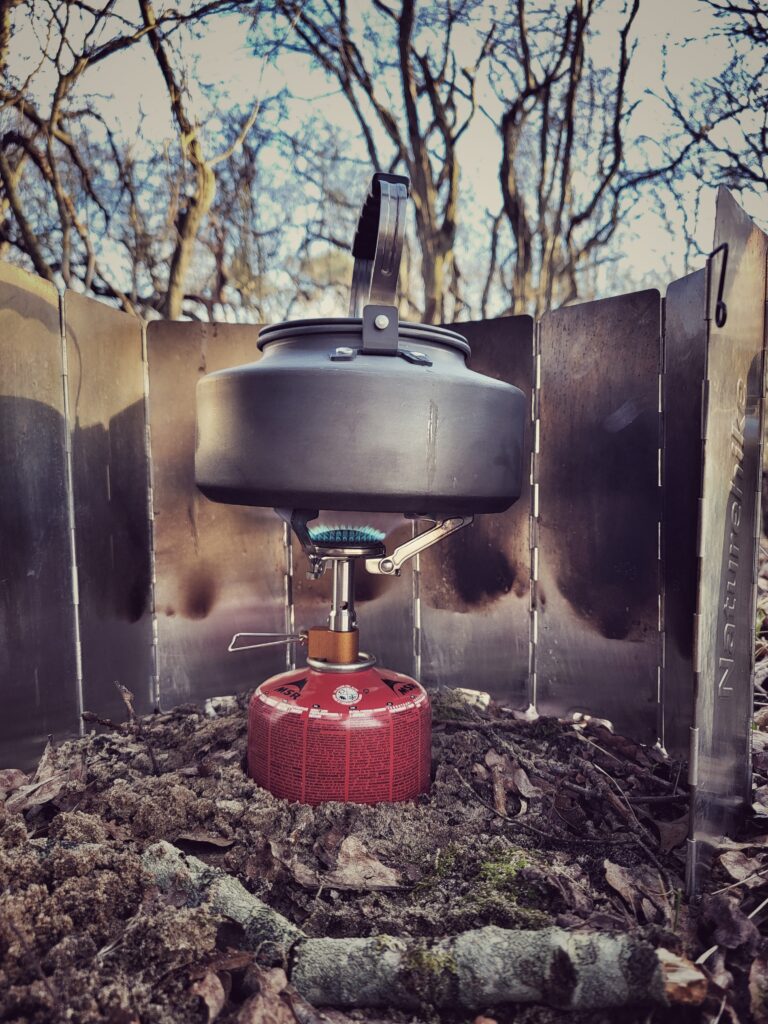
For me, this is the easiest way of cooking when out and about. Screw the stove to the cannister, put it down, light it and you’re done. It is, however, without a doubt, the most uncivilized way of cooking. Gasstoves tend to make a lot of noise and may disturb just about everything around you. When it comes to speed, nothing beats a gasstove. This hold especially true when using a JetBoil or something similar (which I don’t).
Another disadvantage is that cannisters normally can’t be used up fully. When a cannister is close to empty, it will stop working properly. The only solution used to be a new cannister. However, as of late, I’ve been seeing ads for the FlipFuel, a devices used for transferring (butane) gas from one cannister to another one. Personally, I don’t have any experience with the FlipFuel, so if some of you do, please let me know and I’ll update the article.
What do you need: a (small) stove, a cannister of (butane) gas and a lighter. You can use a firesteel to light a gasstove, but I find it overkill. Just use a lighter…
Spirit burner or gasstove or fire
Which one do you prefer?
Option 3: Spirit burner
My first ever outdoor stove was a spirit burner; the Trangia Storm cooker. It was gifted to me by my parents for my first outdoor trip, back in 1998 on a multi-day hike through the Belgian Ardennes. I used it for 10 days straight and I loved it. Yes, it was slow, yes, I had trouble lighting it when it was cold, but unlike the gasstove, it was quiet and peaceful. No loud noises eminating from the cooker, just the water vapor to indicate that the water for my coffee was ready.
The big disadvantage of a spirit burner in general is the weight. Not just the stove itself, which can be extremely small to be honest, but the fuel. I carried around a steel 1-liter bottle of methanol alcohol, which added to the overall weight considerably. Another disadvantage is trying to light the fire when it’s cold, which tends to prove a little more difficult. Small tip: put a small piece of toilet paper in the fuel and light that. It will warm up the fuel in the stove and you’ll have no trouble cooking whatever you desire.
What do you need: a spirit burner, a form of alcohol as fuel (see this list from Trangia for advice) and a lighter. Spirit burners can be lighted with a firesteel, but it takes a lot of sparks and when it’s cold, you can all but forget that.

Spirit burner, gasstove or fire
So, after carefull consideration, my conclusion is that I cannot definitely choose one method of cooking. It all depends on the location, circumstances and basically, your own preference. If you prefer to cook on a spirit burner, more power to ya! If you’re a hardcore bushcrafter that only wants to cook on a wood fire, respect bro! And if you a more weight-consicous backpacker and chose the gasstove, you’re absolutely right! There is no one right option. All three methods have their merits and all three have their disadvantages. As in most things concerning bushcrafting or the outdoors, there is no right or wrong. There’s only personal preference.
So, as far as the choice for spirit burner, gasstove or fire comes, anything goes! Do as your heart tells you and let no one tell that you’re wrong. It’s your choice and yours alone!
Happy cooking!
Beste Jaap,
Zelf vind ik eigenlijk een gasbrander het makkelijkst, het andere is leuk voor als je wat meer de tijd hebt. Ik heb de flipfuel aangeschaft, en ik ga daar mijn 100 grams blikjes mee op niveau houden voor een weekendje weg…. ik heb het allemaal een beetje uitgerekend, en ja ook ik ben altijd bang dat ik te weinig gas bij me heb, wat totale onzin is…. ik heb nog nooit zonder gestaan…
De Savotta Happy Stove is te gek…. Maar al die regeltjes…pffff. Er mag zoveel niet… jammer maar ook wel weer begrijpenlijk vanwege overlast of erger bosbrand!…
Hi Bart, ben het met je eens hoor. Gas is altijd de snelste oplossing. Alleen dat geluid. Ik heb inmiddels ook een FlipFuel gekocht (niet het merk zelf, maar een kloon via Amazon) en het idee is hetzelfde. Ik heb een MSR 110g blikje (lekker formaat dat ook direct in mijn pannensetje past) dat ik daarmee ga bijvullen vanuit de 500grams blikken die ik op voorraad heb.